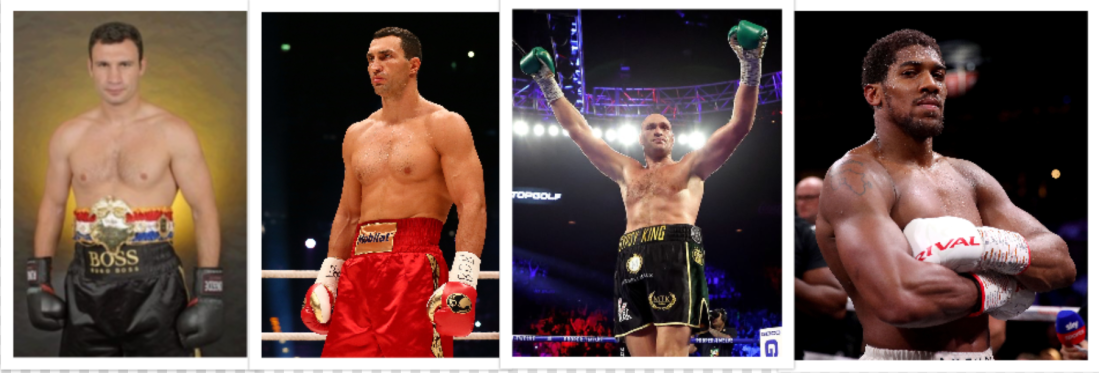
Following his victory over Evander Holyfield, Lennox Lewis was the undisputed heavyweight champion of the world. Unfortunately for him, this reign would only last five months, as he was stripped of his WBA title for deciding to fight WBC mandatory Michael Grant instead of WBA mandatory John Ruiz. Despite losing this title Lewis had a very successful 2000, with two 2nd round stoppages against Michael Grant and Francois Botha and a unanimous decision against David Tua.
The vacant WBA title was put on the line in a match up between John Ruiz and Evander Holyfield. Holyfield was awarded a unanimous decision but the fight was extremely close which prompted an immediate rematch to take place. This time round Ruiz came away with the decision, this back and forth led to a third and final fight between the two to take place in December 2001. The third fight was ruled a draw, meaning that Ruiz retained his WBA title.
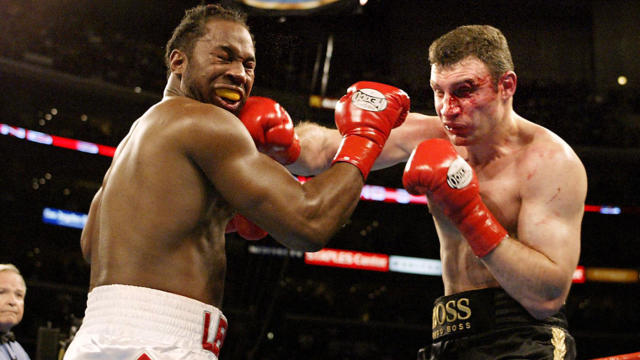
Lewis next defended his titles against American challenger Hasim Rahman in South Africa. At the time Lewis had been appearing in the film Oceans Eleven, which meant that he wasn’t entirely focused or prepared going into the fight. Rahman capitalised on this and knocked Lewis out in the 5th round. The two had a rematch in late 2001, and Lewis got his revenge, landing a perfect 2 punch combination that floored Rahman in the 4th. Lewis was now a 3-time heavyweight world champion. Following him regaining his titles, Lewis finally got the fight that he had been chasing for so many years: Mike Tyson. This was a far cry from the Tyson of the late 80’s, and Lewis looked very comfortable, stopping the former world champion in the 8th round. Following the Tyson fight, Lewis vacated his IBF title for refusing to fight their mandatory challenger Chris Byrd. In June 2003, Lewis defended once more against Vitali Klitschko, a last minute replacement for his original opponent Kirk Johnson. This fight would infamously go on to be known as ‘TKO6’, as, despite the fact that Klitschko was leading on the judges scorecards, the fight had to be stopped at the end of the 6th round due to a horrendous cut caused by a Lewis punch. Lewis successfully retained his WBC and lineal titles for the final time, and retired from professional boxing after the fight.
A year later Vitali Klitschko fought Corrie Sanders for the vacant WBC title. Sanders was coming off a shock 2nd round stoppage victory against Vitali’s brother Wladimir, but Vitali got revenge for his brother, as he stopped Sanders in the 8th round. Vitali made one defence of his title before retiring in 2005, following a snapped ACL injury. This meant that the WBC title was now vacant.
Following retaining his WBA title against Holyfield, John Ruiz successfully defended his title against Kirk Johnson, before former middleweight, super middleweight and light heavyweight champion Roy Jones Jr. stepped up to challenge for the title. Jones completely outclassed Ruiz and won by unanimous decision. He was the first former middleweight champion to win a heavyweight world title in 106 years. Following the fight, Jones vacated the title and moved back down to light heavyweight. 9 months later Ruiz faced off against Hasim Rahman for the interim WBA title, and won by unanimous decision. Following Jones vacating the title, the WBA reinstated Ruiz as the champion.
Evander Holyfield attempted to become a 5-time heavyweight champion on the 14th of December 2002 against Chris Byrd. Holyfield was beginning show his age at this stage of his career, and lost by unanimous decision to Byrd. Byrd successfully defended his title 4 times, before he lost by 7th round TKO to Wladimir Klitschko in 2006. This was the beginning of one of the longest reigns in heavyweight history.
Following Vitali Klitschko’s retirement, Hasim Rahman was named the new WBC champion, but only successfully defended once, in a draw against James Toney, before losing his title to Uzbekistani fighter Oleg Maskaev. Maskaev successfully defended once before being stopped in the 6th round by Nigerian Samuel Peter. However, Peter’s reign was short lived, as he faced former champion Vitali Klitschko, who had come out of retirement, and Peter retired at the end of the 8th round.
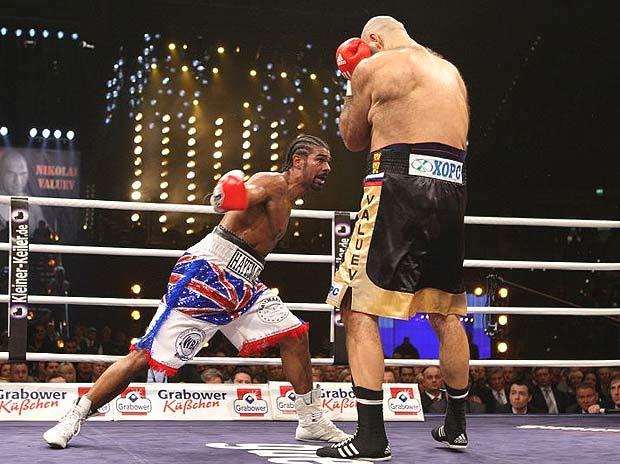
John Ruiz defended his WBA title twice, before the 30th April 2005 when he fought James Toney, initially Toney won by unanimous decision, but failed a drug test following the fight. The fight was ruled a no contest and Ruiz was reinstated as champion. Later that year Ruiz would officially lose his title however, against 7 foot tall Russian, Nikolai Valuev. Valuev was, and still is, the tallest boxer to ever win a world title. Valuev remained champion until 2007, when he lost by majority decision to Ruslan Chagaev. Chagaev retained his title against Matt Skelton, but was stripped of the title soon after, for being unable to face his mandatory challenger, Nikolai Valuev. Valuev instead fought John Ruiz for the vacant title, and again won by decision. Valuev defended his title against former champion Evander Holyfield before losing his title to former Cruiserweight world champion David Haye by majority decision.
In February 2007 the World Boxing Organisation (WBO) became recognised as a major governing body. At the time of this decision, the WBO champion was Shannon Briggs. Just 4 months later Briggs lost his title to Sultan Ibragimov. Ibragimov attempted to unify his WBO title with the IBF in February 2008 against Wladimir Klitschko, but lost by unanimous decision. Klitschko won the vacant The Ring and Lineal titles in 2009 against Russian Chagaev, after Chagaev retired in his corner following the 9th round.
David Haye scored two stoppage victories in his two defences against John Ruiz and Audley Harrison, before facing off against unified champion Wladimir Klitschko. The fight didn’t really live up to the pre-fight hype however, as Klitschko won a comfortable unanimous decision. The Klitschko brothers now held every major world title in the heavyweight division.
Vitali made 9 defences of his WBC title, before announcing his second and final retirement from boxing in 2013. He retied with a record of 45-2 with 41 KO’s. On the 10th May 2014, Bermane Stiverne and Chris Arreola fought for the vacant title. This was a strange decision from the WBC, as the two had fought less than a year earlier and Stiverne had won by unanimous decision. Stiverne made much quicker work of Arreola this timee however, stopping him in the 6th round. Almost a year later Stiverne would attempt to defend his title against unbeaten challenger Deontay Wilder. At the time Wilder had a record of 32-0 with 32 KO’s. This fight was the first time that Wilder went the distance, beating Stiverne by unanimous decision.
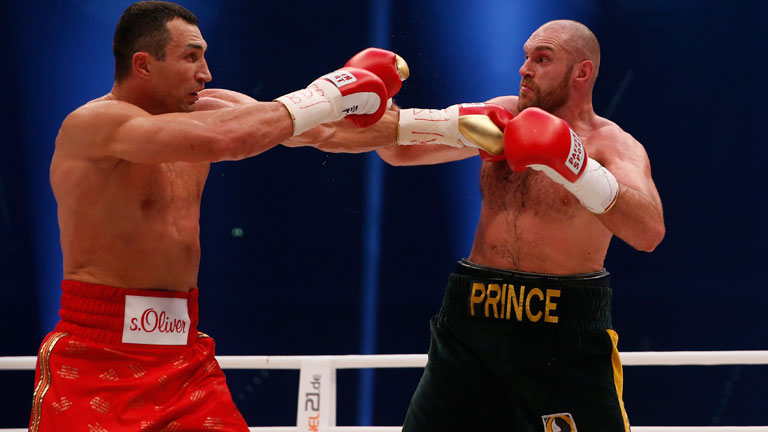
From 2006 to 2015, Wladimir Klitschko made 18 successful defences of his titles, unifying the division multiple times. In November 2015, Klitschko faced unbeaten British challenger Tyson Fury. Fury outclassed, outthought and frankly confused his opponent for twelve rounds, before winning by unanimous decision. Klitschko’s 9 year reign had ended. Just 10 days after the fight, the IBF stripped Fury of his title due to his plans to rematch with Klitschko. The IBF wanted him to face their mandatory challenger, Vyacheslav Glazkov, but Fury refused. The rematch was initially scheduled for July 2016, but the fight was postponed due to Fury being unfit to fight. In September Fury failed a drug test due to the presence of cocaine, and vacated his titles one month later. Fury temporarily retired following this.
In January 2016, Glazkov and Charles Martin faced off for the vacant IBF title. Glazkov injured his knee significantly in the 3rd round and was unable to continue. Martin was ruled the winner and became the new IBF champion. Glazkov never fought professionally again. Just 3 months later Martin was defending his title in the UK against unbeaten Olympic gold medalist Anthony Joshua. Joshua landed two perfect right hands in the second round and won by second round KO. Joshua was now 16-0 and the new IBF heavyweight champion.
In December 2016, Joseph Parker and Andy Ruiz Jr. faced off for the vacant WBO title. The fight was incredibly close, and there are arguments that can be made for both fighters winning, but Parker walked away with the majority decision victory in his home city of Auckland.
In April 2017, former long reigning champion Wladimir Klitschko challenged Anthony Joshua for his title. The vacant WBA title was also on the line. The fight was an instant classic, as both fighters got up off the canvas before Joshua eventually stopped Klitschko in the 11th round. Joshua was now the unified heavyweight champion. One year later, Joshua unified again, this time against WBO champion Joseph Parker in Cardiff. This fight saw Joshua adopt a more cautious style, as he went the distance for the first time in his professional career, and won by unanimous decision. Joshua now held the IBF, WBA and WBO titles.
Following winning the WBC title, Wilder made 6 relatively light defences of his title, before facing his first big step up, Luis Ortiz. The fight was a back and forth chess match in the early rounds, before each boxer landed some huge power shots, with both nearly being stopped. Wilder ultimately ended the fight in the 10th round, with a right uppercut. Then, in December 2018, Tyson Fury challenged Wilder for his title. Fury had had two easy fights before stepping up to face the feared puncher. Many didn’t give Fury a chance, but to many peoples surprise, Fury completely outclassed Wilder, and looked like he’d never been gone. Wilder dropped Fury in the 9th and 12th rounds, but Fury would not stay down, and fought on right until the end. The fight was ultimately ruled a draw, in the biggest robbery of a British fighter in the US since the first fight between Lewis and Holyfield in 1999.
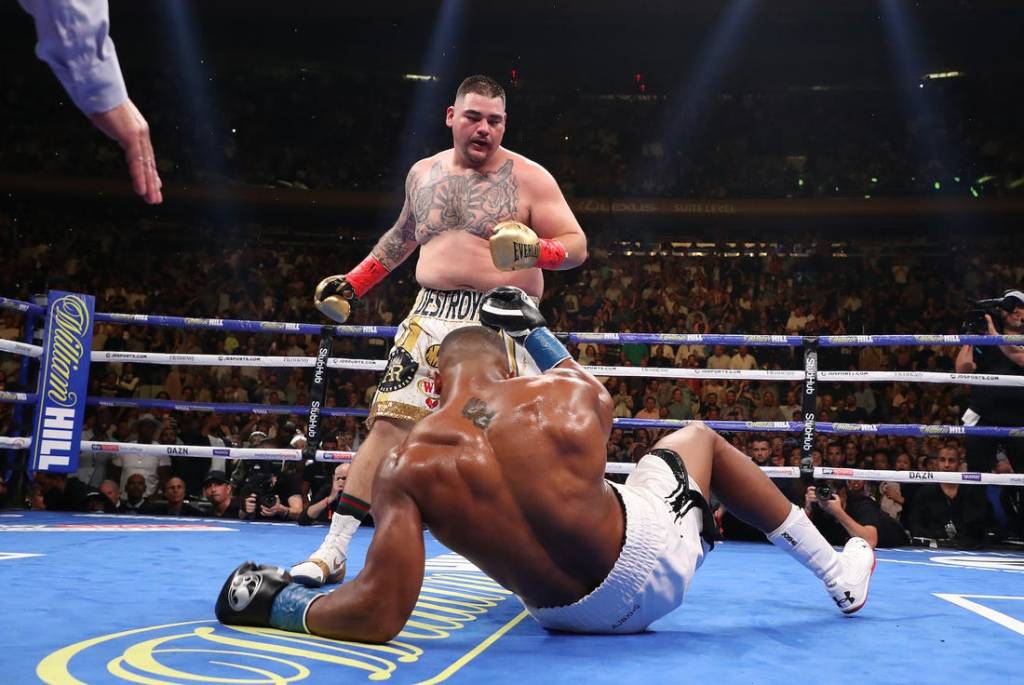
In June 2019, Joshua was originally set to face Jarrell Miller, but two months before the fight, Miller failed two separate drug tests. A replacement was needed and Andy Ruiz Jr. stepped up. Joshua dropped Ruiz mid way through the 3rd round with a perfect two punch combination, but when he then went in for the kill he got careless, and Ruiz caught Joshua with a left hook to the temple that completely threw Joshua’s equilibrium off. Ruiz dropped Joshua twice in that round, and he was lucky to make it to the bell. Through the 4th, 5th and 6th rounds, Joshua didn’t seem himself, although he was slowly beginning to regain his legs. Ruiz went in in the 7th round however, dropping Joshua twice more before the referee stopped the fight. This was arguably the biggest heavyweight upset since Hasim Rahman knocked out Lennox Lewis. The two agreed terms for an immediate rematch that took place later that year. This time, Joshua was far more cautious and Ruiz was far more out of shape. Joshua arguably won all but one round of the fight and regained his titles by unanimous decision.
In February of this year, Wilder and Fury had a rematch of their epic encounter from 15 months before. This time however, Fury completely changed his game plan, as he walked down Wilder and dropped him twice en route to a 7th round TKO finish. Fury winning this fight meant that all of the major heavyweight titles are now held exclusively by British fighters for the first time since the establishment of sanctioning bodies.
 The Knockout Blog